The Local Marketer's Edge Is Deciding What AI Can Run Without a Human
Local SEO expert Jono Slade on sorting AI work by risk, why an unchecked claim can turn into real legal exposure, and how owner expertise is becoming the differentiator that surfaces.
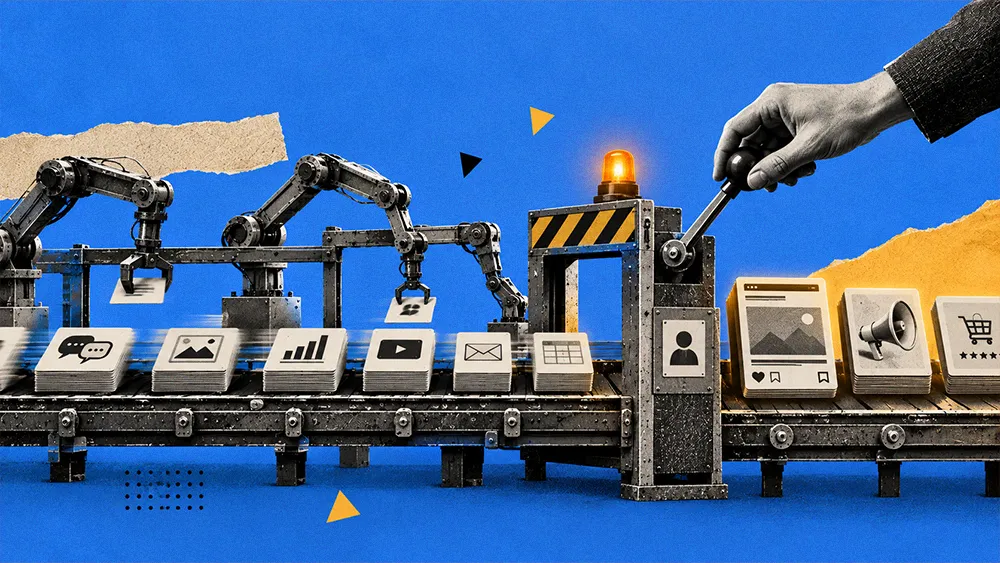

The nice part about AI is that it’s a multiplier. It can do the bulk of the work for you, but you’re still there to review the output, add your own expertise and perspective, and make the final call.


If this caught your attention, that’s not accidental.

The best editorial systems don’t happen by accident. Outlever builds them.


AI has made it trivial to produce marketing at volume, which is exactly why the judgment about what to let it publish matters more than the output. A local business posting AI-written copy is putting its brand, and sometimes its legal exposure, on the line with every unchecked claim. The operators getting value out of these tools aren't the ones automating the most. They're the ones who know which tasks can run on their own and which ones can't afford to.
Jono Slade is the Founder and Chief Strategist of Slade Insights, where he builds AI automations and SEO systems for local and service-based businesses, with a particular focus on specialty contractors. He came into marketing after a stretch in IT systems work, and that systems background shows in how he thinks about workflows: less about what AI can do and more about where a failure would actually land. His starting point is that the technology multiplies a marketer's output without removing the need to check it.
AI is a multiplier, but a multiplier applied to an unverified claim scales the mistake too. "The nice part about AI is that it’s a multiplier," says Slade. "It can do the bulk of the work for you, but you’re still there to review the output, add your own expertise and perspective, and make the final call." The value shows up only when a person stays on the approving end of that exchange.
When a hallucination becomes a liability
The place skipping the check hurts most is where the copy makes a claim the business has to stand behind. Slade points to clients whose product pages carry engineering-backed specifications, where an AI that overstates a rating isn't just off-brand, it's exposure. "I have clients that sell load-rated window well covers, and there's been some hallucinating within the AI making claims that aren't backed by the engineering reports," he says, which opens the door to real liability for the client and for whoever published the page.
That risk sets the ceiling on how much Slade is willing to automate. Most of the damage is smaller, a piece of content that misses the brand voice, but the worst case is severe enough that he builds his workflows around it. "Without those checks, particularly human review on higher-risk content, supplemented by additional AI quality-control layers, you can open up significant liability for the client and ultimately for the person publishing it," he says. The cost of skipping the groundwork is what he's pricing in every time he decides how much rope to give a system.
Sorted by risk, not by task
Rather than treat automation as all-or-nothing, Slade grades each type of content by how much visibility and exposure it carries. A Google Business Profile update is low-risk enough to run on automation with a client approval built into the loop. "Something like a Google Business Profile post is fairly low-risk, easy enough to set your parameters and automate with a client approval in that loop," he says. The parameters do the guardrail work, and the human sign-off stays light.
The heavier the content, the heavier the review. Articles and core pages get more human-in-the-loop checks, with AI supporting quality control rather than running the whole workflow, and anything highly client-facing gets stricter scrutiny still. The same logic extends to how he'd advise a time-strapped owner. Most of it still needs an eye on it, but the owner's own knowledge is the input that changes the output most. "If you as a business owner add your own knowledge into the loop, it makes such a big impact," he says, "and those that have a more authentic voice will ultimately win out and come to the top."
Chasing a moving target
On getting a local business recommended by an AI assistant, Slade describes constant experimentation against conditions that won't hold still. The fundamentals haven't shifted, but the weight different signals carry changes fast, and personalization makes the data almost impossible to read cleanly. "Everything is personalized now, which makes it tricky to have clean data," he says. A logged-in session pulls location and chat history into the result, so a marketer who has run ten chats about a client can't trust what the assistant shows them to reflect what a real searcher sees.
The workaround is imperfect and hands-on. He runs searches himself to see what the AI is pulling from, hunts for tools that can produce cleaner instances, and gets clients answering questions in the places models look for credible authority. That hunt is reviving sources people had written off. "I've seen MapQuest pop up again, platforms you thought were holding less value holding value again," he says, as the AI scrambles for genuine signals of authority, which is hard on a smaller or newer business that can't be everywhere at once.
Proof of value gets harder
Looking out a year or two, the thing Slade expects to get thornier is attribution. The clean click-to-conversion path that let an agency tie its work to revenue is eroding as AI search absorbs more of the journey. "It used to be you could track clicks through to conversions and have a pretty good A-to-B option to say, this is the revenue we delivered," he says. "As AI search pulls more of that away, it's going to be harder to correlate."
Visibility is improving in some respects even as the number of platforms to track it across keeps growing, and he's watching whether Google holds its grip on the new form of search or cedes ground. The open question he's still working on is how to read sentiment and action from what an assistant shows someone, a measurement gap the tooling hasn't closed. For now he'd rather stay diversified than bet a client's whole presence on any single automated play, on the theory that the human judgment layer is what keeps the multiplier from multiplying the wrong thing.
Don’t miss the next one.
Get our latest pieces in your inbox. Leave whenever you want.