Feeling-Led Messaging Is Replacing Data-Led Optimization Across Marketing Operations
Jake "The Wizard" Tlapek shares how AI is compressing the execution layer of marketing while emotion, story, and human taste become the parts of the work that carry.

.svg)
We’re making less informed decisions, moving away from data as our buying signal and more into emotion. I look at brand positioning and brand messaging as this transcendent thing where, no matter where your brand shows up, it’s consistent.


If this caught your attention, that’s not accidental.

The best editorial systems don’t happen by accident. Outlever builds them.


For years, digital marketers chased perfect data and granular tracking as the safest route to campaign performance. Between tighter privacy rules obscuring user behavior and AI agents handling more of the execution work, the data-and-optimization approach is losing the ground it used to stand on. The marketers producing results in this environment are returning to what carries independent of any tracking pixel: a clear message, a strong point of view, and the emotional signal that makes a buyer commit.
Jake "The Wizard" Tlapek started in U.S. Air Force IT before spending two decades building marketing operations that generated more than $100 million in revenue for Fortune 500 clients across three continents. He built and sold two agencies (Brio Studio and Wizard Marketing, the latter acquired by Finch) and now consults independently while building Business Arcanum, an application-only peer group for founders and marketers. His read on the current environment is that the decade-long emphasis on data has left brands over-analytical and risk-averse, and the marketing work that carries in an AI-heavy market starts with the message long before anyone picks a channel.
"We’re making less informed decisions, moving away from data as our buying signal and more into emotion. I look at brand positioning and brand messaging as this transcendent thing where, no matter where your brand shows up, it’s consistent," says Tlapek. His method for building that consistency is to start with one centralized messaging framework and extract specific pieces from it for each channel a brand shows up in. It covers Facebook ads, website copy, Reddit threads, and the way AI overviews summarize the brand. The extraction is where consistency becomes an operational discipline, because the message has to hold its shape across every surface the buyer encounters.
Two directions of compression
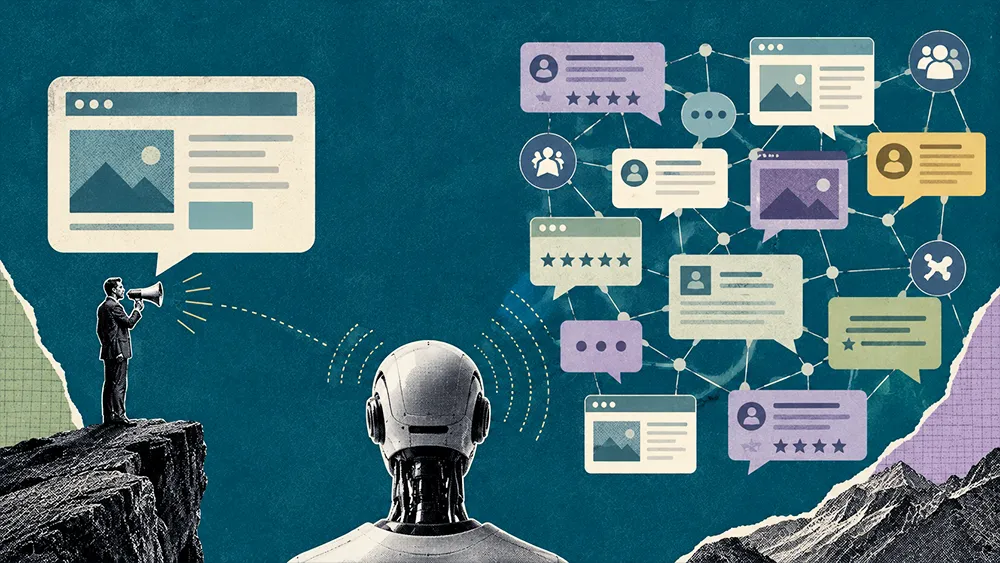
The production side of the marketing operation is where AI's compression of the execution layer is most visible. Baseline writing, placement work, and asset production are moving inside agentic systems at agencies that have historically billed for that work, and ad platforms like Meta are absorbing more of the campaign build inside their own automation. "AI is taking over delivery and execution. That layer of marketing, where so many agencies have monetized themselves over the last 10 or 15 years, is gone or is going to be gone," says Tlapek. "What's left is the stories you tell and why you do the marketing, rather than the doing of the marketing."
The measurement side is compressing in a different direction. Tlapek's read is that the measurement conversation is defaulting back to the top-level ratio marketers used before the tracking infrastructure existed. "Slowly over time, things like GDPR and other restrictions that we've placed on our ability to collect that data have actually taken marketing platforms or groups backwards and they can't prove what they've done as clearly as they used to," he explains. "There is still one thing you can point to, which is marketing efficiency ratio. How much did I spend? How much did I make? That's billboard-era marketing."
The Liquid Death lesson
The paradox in today's environment is that consumers have more product data available to them than ever, and they're outsourcing more of the comparison work to AI systems that pick the best vacuum or software for them. Tlapek's framework for the messaging that reaches the buyer's emotional layer traces surface-level desire back to one of four underlying drivers: identity, greed, fear, or duty. "If I as the business owner can identify the type of person who buys my product and what their base animalistic desire is, I can start to build messaging into that," he explains. "If you're in cybersecurity, fear is a huge motivator for that. But if you're in watches, maybe it's identity. Maybe it's greed. You have to start there."
The other side of the compression is that brands leaning on features alone stop registering with buyers who have delegated the feature comparison to a machine. Tlapek's argument is that the brands cutting through in this environment take a distinct position that some segment of the market will openly reject, because the rejection is the market signal that the brand stands for something specific enough to build loyalty around. His central example is Liquid Death, a water brand that runs its detractors as part of its marketing surface. "When you take a brand and you let it stand for something, you will get haters, and that is a good metric because that also means you have as many, hopefully, lovers as you do haters," says Tlapek.
AI executes, humans decide
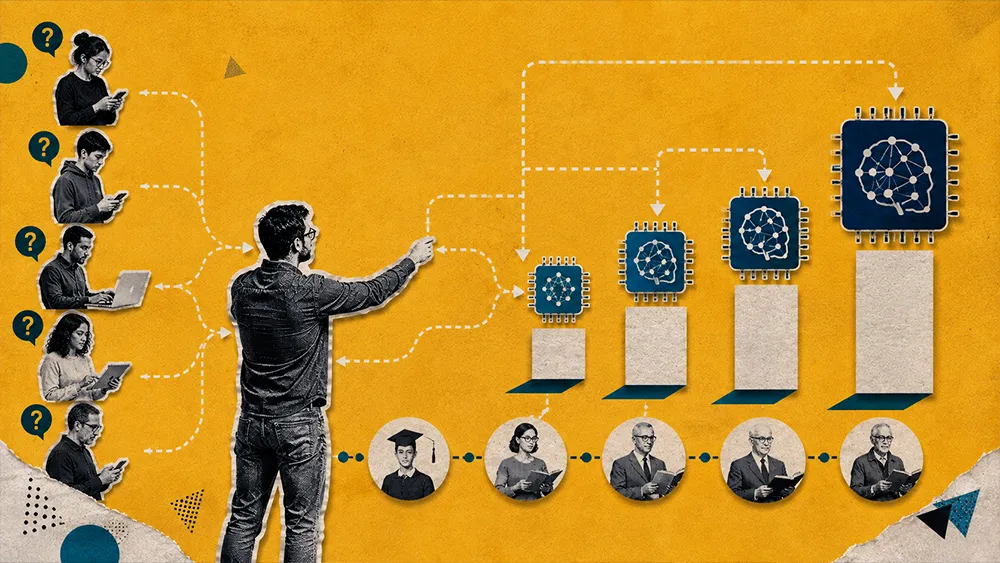
The economic value of human judgment goes up when content generation becomes instant. Generative AI does the heavy lifting well enough to function as the most capable intern a marketing operation could hire, but the tools themselves have no taste, which is where the marketer's job gets concentrated. The specific work that stays with the human is deciding what the finished output should feel like and what would be off-brand, off-target, or off in ways the model has no way to detect.
Tlapek uses image generation as the example. He runs Dungeons & Dragons campaigns as a hobby and needs custom illustrations of characters and scenes he can visualize but cannot draw. The model turns those descriptions into usable art once he tells it what he sees. "I have no artistic talent. I can't draw anything, but I can see it in my mind. If I can communicate that into the AI, it can produce that thing back to me, and then I can refine it," Tlapek concludes. "We have to be that refinement engine, that taste factor, and use the tools as they were always intended to just move us from ideation to making the vision real."
Don’t miss the next one.
Get our latest pieces in your inbox. Leave whenever you want.