More Work, More People: How One Agency Added Roles as AI Cut Production Time
Lauren Petrullo, CMO of Mongoose Media, on why AI augmentation grew her headcount, added QA to every workflow, and why treating AI as a replacement makes you replaceable.

In the past, done meant here's what the copywriter wrote, here's a Google Doc with images and some links. Now done includes SEO QA, full-time QA, account manager QA. We get more expertise and more visibility because AI augments it so we can deliver a better finished product.


If this caught your attention, that’s not accidental.

The best editorial systems don’t happen by accident. Outlever builds them.


Common sense says that if AI can automate more of the work, agencies should need fewer people to produce it. Early research on AI adoption points somewhere more complicated. A study of high-intensity AI adopters found that companies deploying AI operationally grew headcount by roughly 10% in the first two years after adoption, rather than shrinking it. Separately, UK labor-market data shows workers with AI skills commanding wage premiums above 20% over comparable peers without them. The shift is recomposition, not contraction. People do different work, built around workflows that weren't practical before the tools.
Lauren Petrullo, CMO and Chief Imaginologist at Mongoose Media, runs a performance marketing agency and creative studio serving seven-, eight-, and nine-figure brands across advertising, lifecycle marketing, and content. A former innovation producer at Walt Disney Company, she's been building with AI since 2020, when she launched an e-commerce brand using AI-generated creative that reached five figures in revenue.
"Anyone who tells me that AI makes them more efficient, I'm calling it," Petrullo says. "AI makes me more effective. I spend more time on a single task. I take 45 minutes on a prompt because I'm going back and forth. I use AI for coaching, for sparring, for QA." The distinction between efficiency and effectiveness is the operating principle behind how she's restructured her agency's entire delivery model.
More hands per deliverable
The clearest example is blog content. Petrullo's writers previously spent 8 to 15 hours per article handling research, drafting, and revision. With AI in the workflow, a full blog draft takes two to three hours. The time savings led to more people on the project, not fewer.
"We just hired a QA person," Petrullo says. "We now have three people doing QA on every article that comes out." Each piece goes through SEO quality checks, a dedicated full-time QA review, and an account manager's review before it ships. The agency also runs predictive ranking tools to evaluate each article's likelihood of performing before publication. The client price fell from $400–$1,000 per blog to roughly $250, and the agency used the savings to add expertise around the work rather than pocket the efficiency.
Petrullo explains it through a distinction she applies across the agency: the difference between "done" and "complete." A task is complete when a single function finishes its work. A project is done when every layer of review, validation, and strategic alignment has been applied. "In the past, done meant here's what the copywriter wrote, here's a Google Doc with images and some links," she says. "Now done includes SEO QA, full-time QA, account manager QA. We get more expertise and more visibility because AI augments it so we can deliver a better finished product."
"We went from being a collection of freelancers to an actual agency on the fulfillment side," Petrullo says. The expansion of roles came from new categories of work inside the agency: prompt architecture, AI output QA, token usage optimization, and agent monitoring.
Systems before scale
The inflection point for Petrullo's team came last July during what she describes as a "come to Jesus moment." She noticed an over-reliance on AI across the agency. Team members were defaulting to AI-generated output because it was novel and fast, but critical thinking and filtering had dropped off. She asked her team how many of them were worried about losing their jobs to AI by the end of the year. Every hand went up.
"I was shook," Petrullo says. "Because for me, how was that possible when I was like, I can't let go of you, there's no replacement. But the way they were using AI was trying to replace their day-to-day tasks versus augmenting to make their role more effective." The problem wasn't the tool. It was the absence of governance around how the tool was being used.
Her response centers on a principle she borrows from mathematics: order of operations. "If you treat AI like a calculator, which is a great tool, and you don't put the parentheses in the right way, you can have a completely different answer," Petrullo says. "You have to instill these rules, these control centers, as if they were part of your system." Human and AI errors need different safeguards. Humans miss deadlines, misread briefs, and make bad judgment calls. AI hallucinates, overgeneralizes, and produces confident answers that can be structurally wrong. The system needs fail-safes for both.
The ownership question comes down to structure, and culture follows from it. Petrullo's position is that AI adoption has to be CEO-led because employees won't drive it themselves. "There's a bigger fear that this will replace their job," she says. "So the CEO, the ownership of AI adoption, has to come from the top." She also pushes back on the pressure marketers feel to chase every new tool and capability. Her preference is depth over breadth: get exceptionally good at a few systems rather than mediocre at dozens.
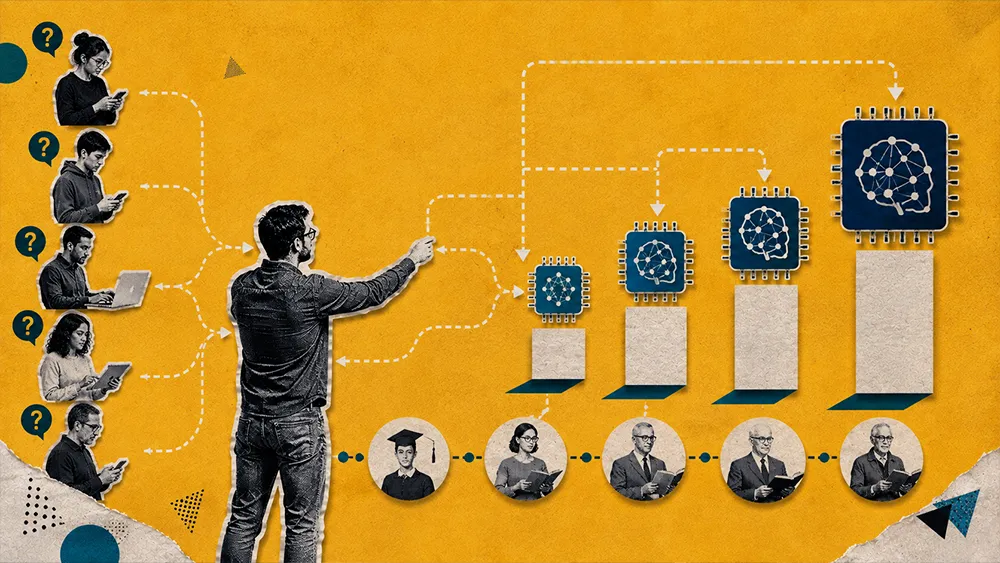
The next frontier she sees is token efficiency: teams learning to route work to appropriately sized models rather than defaulting to the most powerful option for every task. Her agency already runs a model garden that shifts between available models based on the complexity of the request. "A large language model is giving you the high emeritus professor's answer," Petrullo says. "A small language model is giving you a high school teacher's reply that knows enough to answer the question. You don't always need the most expensive model running."
AI made more expertise economically possible, expanding the roles around the work rather than eliminating them. The agency's advantage is that the efficiency gain can now support more judgment, QA, and specialization around the same deliverable.
Don’t miss the next one.
Get our latest pieces in your inbox. Leave whenever you want.