Local Marketing That Actually Works Runs on Documented Systems, Not Busywork
Gary Donson makes the case that the difference between marketing that moves the needle and marketing that just stays busy is whether every step is documented and tied back to a number.
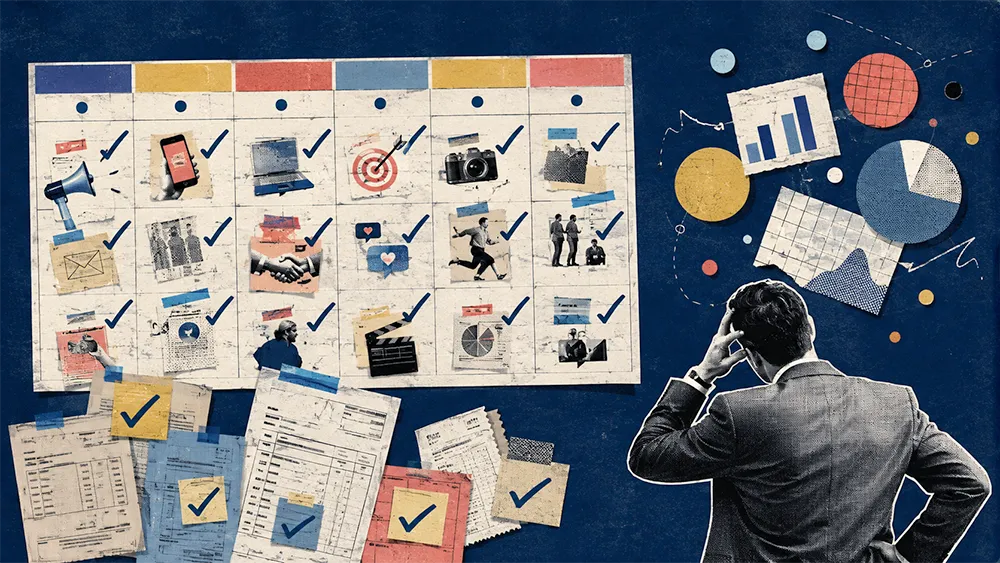

You really have to have the steps well outlined, who's doing them and when they're done, and then at the end of the day, did it make a difference?


If this caught your attention, that’s not accidental.

The best editorial systems don’t happen by accident. Outlever builds them.


Plenty of small business marketing stays perpetually busy without ever proving it worked. Posts go out, tactics get tried, vendors get paid, and six months later nobody can say which of it actually moved a metric. The operators who break that cycle share one habit that has nothing to do with any specific channel: they document every step and tie it back to a result, so effort can be checked against outcome rather than assumed.
Gary Donson is the Founder of Think Donson, a full-service marketing firm that operates as an outsourced marketing department for small and midsize businesses. He's spent more than 15 years handling branding, design, and digital strategy for owners who came to him after other approaches fell flat, and his read on why so much local marketing underperforms is that it was never built to be measured in the first place.
For Donson, a system is less about software than about documentation, knowing exactly which steps ran each month and who owned them. "Without a system in place, that would be impossible to do," says Donson, describing the work of correlating six months of activity against the metrics it was supposed to move. Get that record right and marketing becomes something you can audit; skip it and every result is a guess.
The record is the system
The reason documentation comes first is that search and AI work only counts if you can prove it moved something. Donson's team tracks its metrics, but the metrics mean nothing without a clear log of what was done to produce them. "You really have to have the steps well outlined, who's doing them and when they're done," he says, "and then at the end of the day, did it make a difference?" The documentation is what turns a busy month into an answerable question.
That discipline is also what lets him assign and reassign work without losing the thread, whether the people doing it sit on an internal team or at an agency. The steps stay the same regardless of who runs them, which means the system survives staff changes and hands the business a way to prove the return instead of trusting that the effort paid off. Without it, six months of activity is just activity.
One roof, with a catch
Consolidating a scattered tool stack under one platform is the shift Donson has made in his own shop, and he's candid about both sides of it. Cutting the number of tools in half saved money and, more than that, saved the hours he'd otherwise burn keeping up with a stack that changes constantly. "The technology is changing at light speed right now," he says. "Every time we go to refresh our dashboards, they've made a change in the UI or functionality," and chasing those changes across many tools costs more time than it did even a year ago.
The tradeoff is concentration risk, and he doesn't soften it. He puts his own reliance at roughly 80 percent on Search Atlas, with the other 20 percent a standing frustration about glitches and the pace of change on a platform trying to do a great deal at once. What the consolidation buys back is capacity he didn't have before. He recently took on a client spending $40,000 a month on Google Ads, an account he says he'd have declined a year ago, because the automation lets his team spin up and optimize campaigns without a Google Ads specialist doing every step by hand.
The gatekeeper stays human
Automation handles most of the volume, but Donson is firm about where it stops. His team can run a playbook that analyzes an entire ad account and returns a stack of recommendations, and every one of them still gets read individually against what he knows about the client. "You absolutely cannot let automation run 100%," he says. "It can do probably 90%, but that 10% has got to be a person who knows the client, knows the account, knows what they want."
The stakes are what justify the review. A single wrong budget change waved through can do real damage to a campaign, so the human sits at the gate rather than in the workflow. He expects that split to hold even as the tools improve, moving from 90 to maybe 95 percent over the next stretch without ever reaching the point where the judgment can be handed off. "There's always got to be somebody in there," he says. "I don't know how you teach an AI that."
Fix the measurement first
Before any campaign runs, Donson finds the same gap in most businesses: they aren't tracking conversions, or they're tracking them badly. A lead-gen business will take phone inquiries without proper call tracking in place, which leaves the whole operation flying blind on what's actually working. "Nine times out of ten, they're not even tracking what we'd call a conversion," he says, "and even if they are, it's usually inadequate the way it's set up."
His fix starts with a question rather than a tactic: what do you want someone to do once they're on your site, and how do we turn that into something measurable. Some answers are straightforward, like e-commerce, and some are genuinely hard, like a restaurant whose visitors just browse a menu. Looking ahead, the measurement that matters most is AI visibility, tracking how a business shows up inside assistants like ChatGPT, which he calls the question clients raise every single day. The tools that only report that standing in AI are half the answer, in his view; the ones worth using also hand back a set of tasks that change where you land.
Don’t miss the next one.
Get our latest pieces in your inbox. Leave whenever you want.