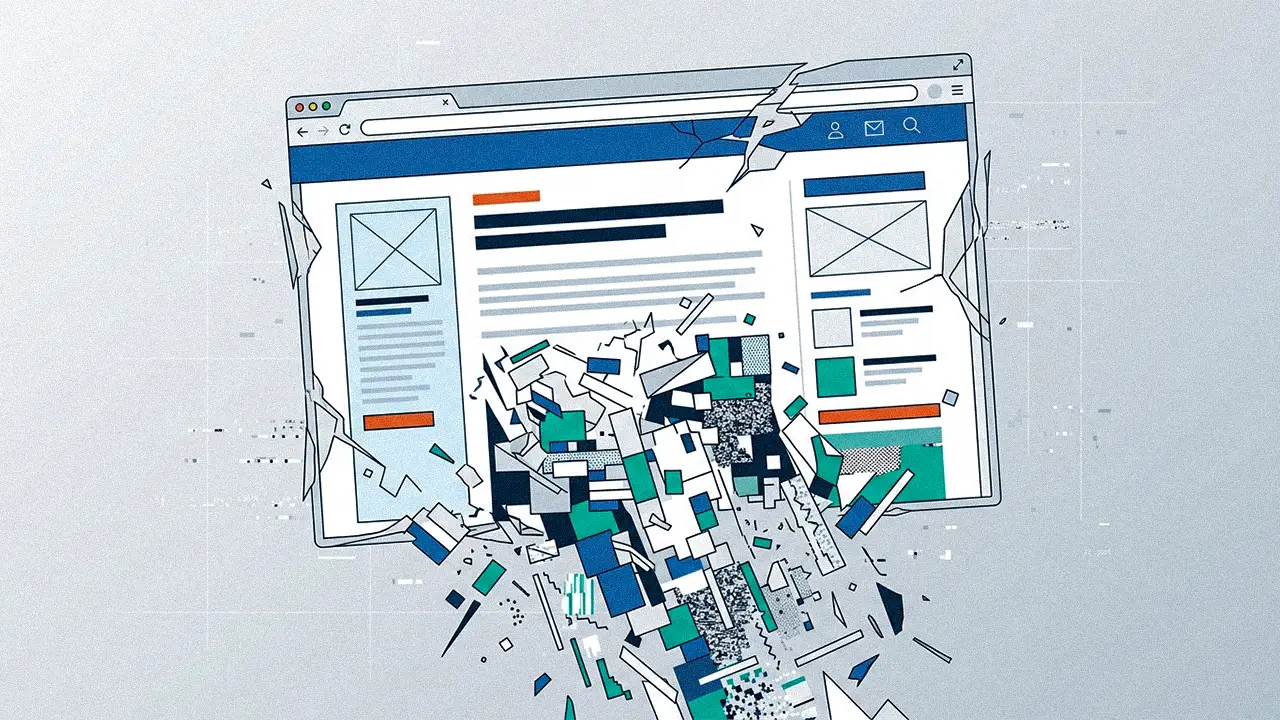
Two Decades of Keyword-Era Content Has Turned Into a Liability Under AI Search
Ranking for the right keywords was the whole game for twenty years. Slake founder Evan O'Brien on why AI search has flipped that, turning a legacy brand's stockpile of generic content into cleanup work while new entrants build clean.
.svg)
Every new technology wave comes with a slop era, and the keyword slop era was the longest, lasting about a decade. In the agentic web, if you aren't credible, you're invisible.

If this caught your attention, that’s not accidental.

The best editorial systems don’t happen by accident. Outlever builds them.


For two decades, a brand could win search by owning the right keywords and stacking up backlinks, and plenty of businesses paid an agency to do exactly that, year after year. AI search has changed what that pile of content is worth. Answer engines now weigh genuine authority and recency, which means a stockpile of generic, keyword-era pages reads less like a moat and more like evidence a brand was gaming the system. The operators who see this are spending less time producing more content and more time cleaning up what's already there.
Evan O'Brien is the Founder of Slake, a go-to-market and agentic-implementation agency that works mostly with SMBs and runs over 200 managed accounts. He came into marketing from the entertainment world, where he worked as a producer, writer, and comedian, and he leans on that research-and-English-lit background to read the reports and data most operators skip. Slake partners with Wix and Perplexity and specializes less in marketing generally than in a single client's marketing and systems, which shapes how he reads the current moment.
His read starts with a pattern he's watched repeat. "Every new technology wave comes with a slop era, and the keyword slop era was the longest, lasting about a decade," says O'Brien. "In the agentic web, if you aren't credible, you're invisible."
The bill for the slop era
O'Brien traces a lineage of slop through every platform shift. The early 2000s brought banner ads and interruption marketing, what he calls billboards on the internet popping up everywhere on AOL and Yahoo. That gave way to cookie slop, then to keyword slop, the longest era of the three, where agencies built entire divisions on keyword and key-phrase work with, in his words, not a lot of ingenuity. Legacy brands arrive at his door carrying two decades of it. "They'll say, 'We have 20 years of outdated marketing,'" says O'Brien, describing companies that paid an agency and a click farm to make them the authority and never had to think about it.
The problem is what that content actually says. A mortgage company with total keyword dominance and a decade of backlinks, he notes, is usually sitting on pages that come from what he calls Planet Generica, copy that means nothing and exists only to rank. That was fine when ranking was the whole job, and it's a problem now that the pages have to demonstrate something real. Producing more of the same at machine speed only deepens the hole, since content at volume without authority underneath it is exactly what the new systems discount.
Recency bias flips the asset
What turns that history from an asset into a drag is how search now reads age and authority. When the concepts on a page are outdated and the strategies behind the posts are old, O'Brien says, the engines interpret it as an attempt to work the system rather than a genuine source. "There's a really big recency bias with search," he says. "If the concepts are outdated, Google looks at that and goes, okay, we get it, this isn't a valuable source." The dominance that took twenty years to build stops carrying weight in the exact moment the brand assumed it was safe.
So a lot of Slake's work is triage, cleaning up what he describes as miles of slop for large organizations that thought their marketing was handled. The flip side is that newer businesses get to skip the cleanup entirely, building for how models weigh authority from the start. "The new kids on the block get to benefit," says O'Brien, "because they're having everything set up the correct way for this era."
Selling systems, not services
The bigger change in how O'Brien sells is that the deliverable is no longer a service but a working system. Rather than hand over a website or a campaign, Slake maps every link in the chain, how sales talks to the CRM, how the CRM talks to the site, how the tools connect, then looks for two things: where work can be automated, and where knowledge is falling through the cracks. "We're selling systems now as opposed to selling services," says O'Brien, who reframes the usual pitch about leaving money on the table into leaving insights on the table instead.
That framing is also why legacy clients burned by big consultancies come looking for a specialist. Slake doesn't specialize in marketing, he says, it specializes in a given client's marketing and its system, orchestrating the whole thing agentically rather than bolting tools onto a broken process. He's blunt about the limits of the technology in that work: he doesn't assume an AI will intuit anything, and if he can't prompt it, in his phrase, it doesn't exist. The value comes from finding data nobody has plugged in yet, not from waiting on a model to have an idea.
The cost of inaction
One metric O'Brien has added to his pitch is the cost of doing nothing. Where owners used to weigh marketing purely on revenue and efficiency, he can now model what standing pat actually costs a business, a calculation he says he couldn't have run himself before AI gave him access to a client's data and their old partners' data. "Here's the cost of not doing anything," he says, describing it as the number that shifts a decision more than any of the usual top-of-mind concerns, and one that helps him tie the work to outcomes a skeptical owner can see.
The results he points to are concrete. Over the last 30 days, he says, Slake deployed 2,701 actions for five clients and reclaimed 244 hours, roughly a full-time employee and a half, which at around $50 an hour lands near $12,000 in recovered time. What he likes about the agentic model is that it's honest in a way SEO rarely was. Scaling an old-school SEO shop, he notes, used to require gray-hat tactics he never had the stomach for, and this work gives clients a straightforward, one-to-one result: put this in, get that out.
Talk to the owner, not the AI
For all the automation, O'Brien insists the highest-value input is the one no tool can produce. He doesn't want to talk to a client's homemade dashboard, he wants to talk to the owner about what the technology can't glean, what's coming up on sales calls, what the boots on the ground are hearing, which collateral is suddenly working. "I don't want to talk to your AI, because we built your AI," says O'Brien. "I want to talk to you about the things this technology can't get from any source." That human signal is where he finds the insight the data misses.
It also shapes how he handles owners who show up with something they built themselves, the vibe-coded site or the half-finished dashboard he compares to an island of misfit toys. He treats it as information rather than a mistake, reading their choices for how they make decisions the way he'd read the judgment a machine lacks, and he refuses to criticize the effort, on the theory that nobody loves their own creation more than the person who made it. His answer to a DIY build nobody can maintain is to channel the eagerness behind it, give the owner real ownership of the system, and speak to the person rather than to their lack of marketing acumen. "Being a business owner is really hard, it's really scary," he says. "I've found a lot of success speaking to the owner and not to the action."
Don’t miss the next one.
Get our latest pieces in your inbox. Leave whenever you want.